

Most homeowners clean the lint trap after every load and consider dryer maintenance done. The lint trap, however, catches roughly 25% of what the dryer produces. The rest accumulates in the vent duct—gradually, invisibly, and with consequences that go well beyond slower drying times.
According to the National Fire Protection Association, clothes dryers cause approximately 13,820 home structure fires annually, with failure to clean identified as the leading contributing factor in 34% of those fires.
Dryer vent cleaning is not optional maintenance—it is what separates a functioning appliance from a fire hazard. These ten signs tell you the vent is overdue. Some are obvious. The dangerous ones are the easy-to-rationalize ones near the end of the list.
The 10 Signs:
1. Clothes take more than one cycle to dry. A load that finished in 45 minutes now needs 80. Most homeowners blame the dryer. Almost every time, the dryer is fine—the duct is not. Restricted airflow traps heat inside the drum instead of exhausting it. The machine runs longer, costs more to operate, and the problem compounds each week.
2. The dryer is hot to the touch—not warm, hot. There is a meaningful difference. Warm means the appliance is working. Hot enough to pull your hand back means heat has nowhere to go and is transferring through the cabinet. I have put my hand on dryers at service calls and pulled it back within a second.
3. You smell something burning. Lint is dry cellulose — it ignites, and a restricted vent raises internal temperatures well above what the appliance was designed to handle. The smell is faint, papery, and easy to dismiss as a stray tissue or a shirt label. Stop the dryer. Do not run another cycle before inspecting.
4. The laundry room feels warm and humid after a cycle. Hot, moist air that has nowhere to go comes back into the room. If your laundry space has become noticeably warmer or more humid over the past year and nothing else changed—no new appliances, no plumbing work—that is not a coincidence. The duct is the cause.
5. The exterior vent flap is not opening fully. Step outside while the dryer runs and watch the vent hood. That flap should open and stay open for the full cycle. A flap that barely cracks or does not move means the airflow pressure is too low to operate it. Blockage is almost always the reason.
6. Lint is visible around the vent opening or behind the dryer. When I open the wall cavity behind a dryer that has not been serviced in years, what I find is not light and powdery—it is dense, compressed, and the color of fired clay. Lint spilling out around the exterior hood or at the wall connection is the overflow. The duct cannot hold any more.
7. Clothes smell musty out of a full cycle. A dryer that cannot expel moisture recirculates it. The drum fills with the same humid air it was trying to remove. Laundry coming out smelling like it sat wet is a ventilation problem, not a fabric softener problem.
8. The dryer shuts off before the cycle completes. Modern dryers have thermal cutoffs that trip when internal temperatures exceed safe thresholds. A dryer turning itself off mid-cycle is not malfunctioning—it is working exactly as designed, cutting power to prevent a fire. The problem is that it keeps reaching those temperatures.
9. Drying times have been quietly increasing for months. This is the most dangerous sign on the list—not because it is the most severe, but because it gets normalized. A load that took 40 minutes now takes 65. You adapt, adjust, and stop noticing. By the time the vent is genuinely hazardous, the longer runtime has become the new baseline. If you cannot remember the last time a full load finished in a single cycle, that memory is the sign.
10. It has been more than a year since the last cleaning. The U.S. Fire Administration recommends annual dryer vent maintenance for typical household use and every six months for households running five or more loads weekly. If you cannot remember the last cleaning, the answer is clear.
When to Call a Professional for Dryer Vent Cleaning
Signs 3, 7, and 8 appearing together are not a situation to monitor. They are in a situation to act on before the next load.
Dryer vent cleaning services for a standard single-story home with a short exterior run typically complete in 30 to 45 minutes. Multi-story homes, rooftop vents, and long duct runs require professional-grade equipment—rotary brush systems and air-pressure tools that access the full duct length. Most residential vents run 15 to 35 feet. The brush kit from the hardware store cleans the first 18 inches.
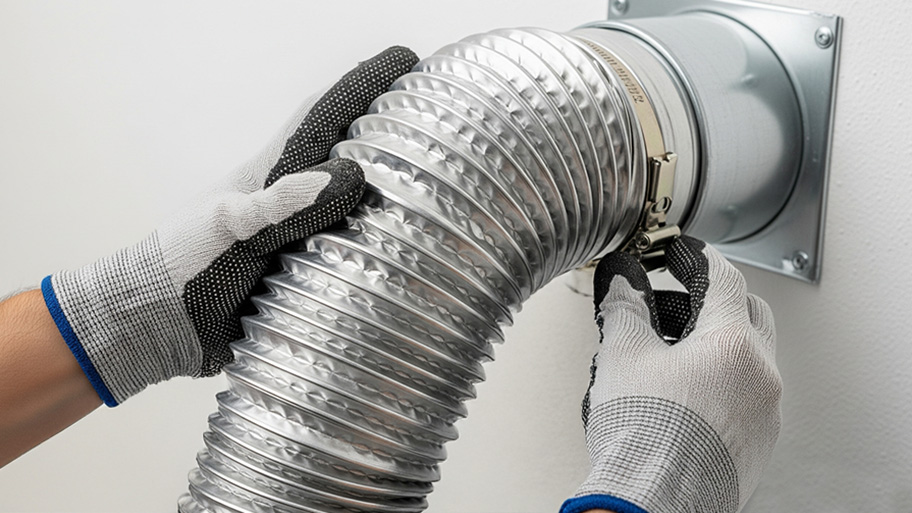
Professional dryer vent cleaning also identifies a hazard most homeowners do not know to ask about: flexible foil duct—the accordion-style connector behind most dryers. The CPSC specifically flags it as a fire risk because it traps lint at every fold. Professionals replace it with rigid or semi-rigid metal duct during the same visit.
Frequently Asked Questions:
Q1: What are the best vacuum attachments for dryer vents?
The best vacuum attachments for dryer vent cleaning are long, flexible hose attachments, lint brushes, and narrow crevice tools designed to reach deep into the vent system. These tools help remove lint buildup, improve dryer efficiency, and reduce the risk of dryer fires.
For the best results, choose a dryer vent cleaning kit that is compatible with your vacuum and can access hard-to-reach areas. While DIY tools can handle light maintenance, professional dryer vent cleaning is recommended for thorough removal of debris and blockages.
Q2: What are the professional dryer vent cleaning tools?
Professional dryer vent cleaning tools include high-powered vacuums, rotary brush systems, flexible rods, compressed air tools, and video inspection cameras. These specialized tools are designed to remove lint, debris, and blockages from deep inside dryer vents, improving airflow and reducing fire hazards.
Many dryer vent cleaning professionals also use HEPA-filtered equipment to contain dust and maintain indoor air quality. Regular cleaning with professional-grade tools helps improve dryer efficiency, lower energy costs, and extend the lifespan of your appliance.
Q3: Is a slow dryer a safety issue or just an efficiency problem?
Both—and the risk grows the longer it is treated as only an efficiency issue. Progressive restriction raises internal temperatures, stresses thermal components, and compresses accumulated lint into a denser fuel load near the heating element. The NFPA data is direct: failure to clean is the leading factor in dryer fires. Annual cleaning eliminates the most preventable cause with one straightforward visit.
Final Thoughts:
The pattern I see most often is a homeowner who noticed the dryer slowing down months ago, adapted to running double cycles, and never made the connection. The vent cleaning that would have resolved it costs a fraction of a new appliance—and a fraction of what fire damage costs. Home dryer vent cleaning once a year is not a premium service. It is the maintenance step that keeps a high-temperature appliance out of the category of things you wish you had handled sooner. If three or more signs on this list sound familiar, this week is the right time to act.