The median American home is now 44 years old — the oldest on record, up from 39 in 2013 and 28 in 1993, according to Harvard’s Joint Center for Housing Studies. Inside that number sit tens of millions of supply lines, water heaters, and sump pumps approaching the end of their service lives at roughly the same time.
That aging curve sits underneath demand for a water restoration franchise, and it explains why this service line behaves differently from the rest of the industry. Fire and storm work arrives in bursts. Water work arrives continuously, because building components fail on their own schedule rather than the weather’s.
The Oldest Housing Stock on Record:
This is a cohort effect, not gradual drift. The construction slowdown after 2008 meant far fewer new homes entering the inventory, while better materials kept older houses in service longer. Census figures show the share of owner-occupied homes at least 45 years old climbing from 39% in 2014 to 47% in 2024, while the share built within the previous 14 years fell from 18% to 13%. That bulge is still moving through the inventory, and it hasn’t crested. Concentration is regional: New York’s owner-occupied homes carry a median age of 64 years, with Massachusetts and Rhode Island near 59.
Why Aging Homes Fail in Clusters:
A house doesn’t decline evenly. Galvanized supply lines, water heaters, clay sewer laterals, and sump systems approach the end of their serviceable lives on similar timelines, so a 44-year-old home presents failures together rather than one at a time. One material makes the point concrete. The median U.S. home was built around 1980 — squarely inside the window when builders ran polybutylene supply pipe through an estimated six to ten million homes between 1978 and mid-1995. Chlorine in treated municipal water degrades it from the inside until it turns brittle and splits. The Cox v. Shell Oil settlement that once covered those failures closed its claim window in 2009, so today’s ruptures land on homeowners and their carriers.
Deferred maintenance sharpens the pattern. Harvard’s research found the oldest homes are disproportionately occupied by owners least able to fund repairs — among homes built before 1960, the top income quintile spent three times what the bottom spent on improvements. In 2023, HUD classified 2.9 million owner households as living in moderately or severely inadequate units, citing water leaks and plumbing defects among the deficiencies.
That gap between needed and affordable maintenance converts a planned plumbing replacement into an emergency. One is a plumber’s appointment. The other is a restoration job.
Steady Demand Rather Than Storm Chasing:
Triple-I puts water damage and freezing at roughly 1 in 60 insured homes annually, around 22.6% of all homeowners claims, with average payouts in the $14,000 to $15,000 range. Wind and hail is more frequent overall at about 1 in 35 — but it’s catastrophe-driven and geographically concentrated. Water is the leading non-weather cause of loss, which is why the calendar fills rather than spikes.
Seasonality shifts the mix without emptying it:
- Winter brings freeze losses. Roughly 20% of home water damage claims involve frozen pipes, averaging near $18,000 — several times a typical water loss. Risk climbs sharply below 20°F.
- Spring brings thaw, saturated ground, and sump pumps failing under sustained load.
- Summer and fall bring storm intrusion, roof leaks, and HVAC condensation.
Warm markets aren’t exempt. California reports elevated water damage incidents driven by aging housing and exterior pipe placement — the aging-stock effect operating independently of freeze risk.
What the Work Actually Requires:
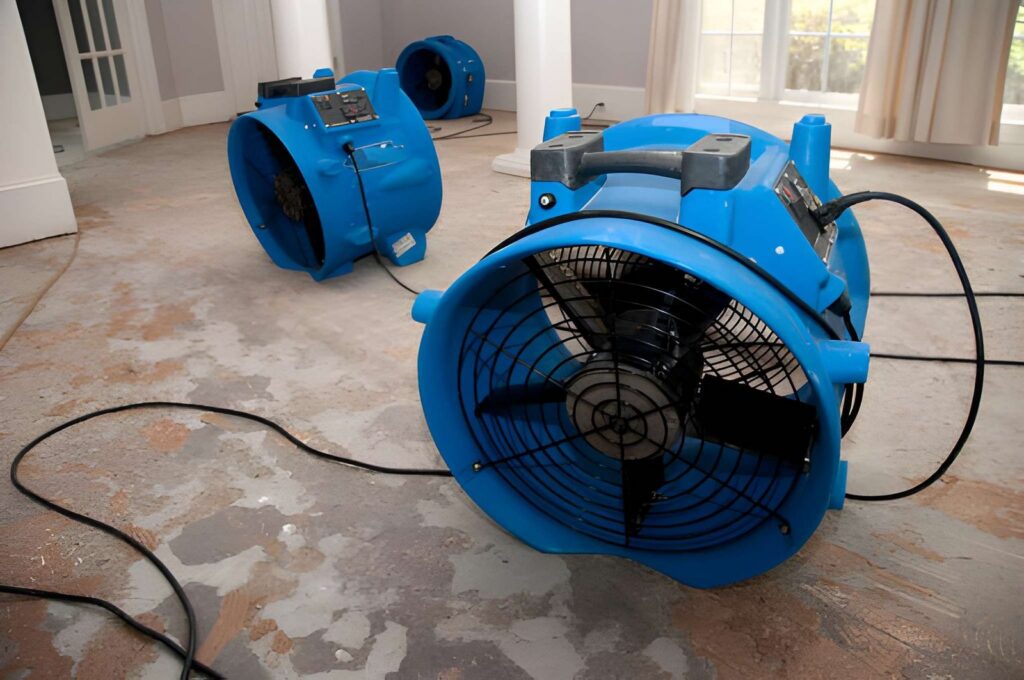
Water is equipment-intensive. A mid-size loss commonly needs eight to twelve air movers and two to four commercial dehumidifiers running three to five days, plus extraction units, moisture meters, and thermal imaging. Certification carries equal weight. IICRC’s Water Damage Restoration Technician credential is built on the ANSI/IICRC S500 standard — the consensus reference adjusters work from — and leads on to Applied Structural Drying. Documentation matters as much as drying: moisture logs, daily records, and photographs are what keep a file from being returned.
That combination is what water damage restoration franchises supply on day one rather than through trial and error, though depth varies enough between brands to be worth probing. Which drying standard do the protocols follow? What documentation are technicians trained to produce? Steamatic’s water damage restoration services sit within a network operating since 1968, and its franchise information covers how that training is delivered.
FAQs:
Q1. If demand is this steady, isn’t the market saturated?
Restoration remains highly fragmented, dominated by small independents. The binding constraint is operational — equipment inventory, certification, and carrier relationships — rather than a shortage of work.
Q2. What certification does a new owner need?
IICRC WRT is the baseline, built on the S500 standard. Applied Structural Drying is the usual next step for technicians.
Q3. Does a franchise help with insurance work specifically?
It can. Recognized documentation standards and existing carrier familiarity shorten the time files take to clear without dispute.
Q4. Are older markets better territories?
Housing age is one signal among several. Climate exposure, commercial density, and competition matter alongside it — a disaster restoration franchise evaluation should weigh all four.
Final Thoughts:
Demand for a water damage restoration franchise rests on something slower-moving than weather: a housing stock that keeps getting older while the money to maintain it gets tighter. Those two curves have been diverging for two decades.
For anyone evaluating territories, the useful questions are about buildings rather than headlines. How old is the stock, what was it plumbed with, who owns it — and how much of that inventory is past the point where deferred maintenance turns into a 2 a.m. phone call?