
The carpet looks dry. You ran a fan for three days; the surface feels firm underfoot, and the visible water is gone. Most homeowners stop there—and most regret it. What happened above the carpet line is recoverable. What happened below it is the problem. Carpet systems—pile, backing, pad, and subfloor—absorb and hold moisture in a way that no consumer drying equipment fully resolves.
The humidity, the organic material in the fiber, and the undisturbed environment beneath the pad create conditions that bacteria and mold do not just tolerate—they require. Calling a qualified water remediation company before that process advances is not a precaution. It is the difference between a restoration and a demolition.
The Part of the Carpet That Does Not Dry:
I have pulled back carpet on jobs where the surface felt completely dry—dry enough that the homeowner was genuinely surprised we were still there. The pad underneath was saturated. Not damp. Saturated, compressed, and already starting to smell.
Polyurethane foam padding absorbs up to 1.5 gallons of water per square foot and releases it slowly without mechanical extraction. Carpet backing is semi-impermeable—water passes through going down and resists release going up. Surface fibers shed moisture and feel dry to the touch while the material beneath them stays wet, warm, and undisturbed. That is not a drying problem. It is a biology problem waiting to start.
The subfloor is where it gets expensive. Oriented strand board and plywood swell, delaminate, and begin structural deterioration within 72 hours of sustained saturation. By the time the carpet surface feels dry, the material two inches below may have been compromised for days.
The 24-Hour Window Nobody Talks About Honestly:
The EPA confirms mold begins colonizing wet organic material within 24 to 48 hours. Carpet fiber, backing, and foam pad are exactly the organic, porous, warm substrates mold colonizes fastest. Under optimal conditions—65 to 80°F, humidity above 70%—spread can cover substantial areas within 72 hours of a water event.
Here is what that timeline means at ground level: a flood discovered Monday evening and professionally extracted Tuesday afternoon has already been incubating contamination for 18 hours. A homeowner who runs fans for three days before calling has not paused the biology. They have given it the best conditions available.
Water damage restoration professionals prioritize extraction speed because the 24-hour window is not a guideline—it is the biological threshold after which scope and cost often double.
Drying and Cleaning Are Not the Same Thing:
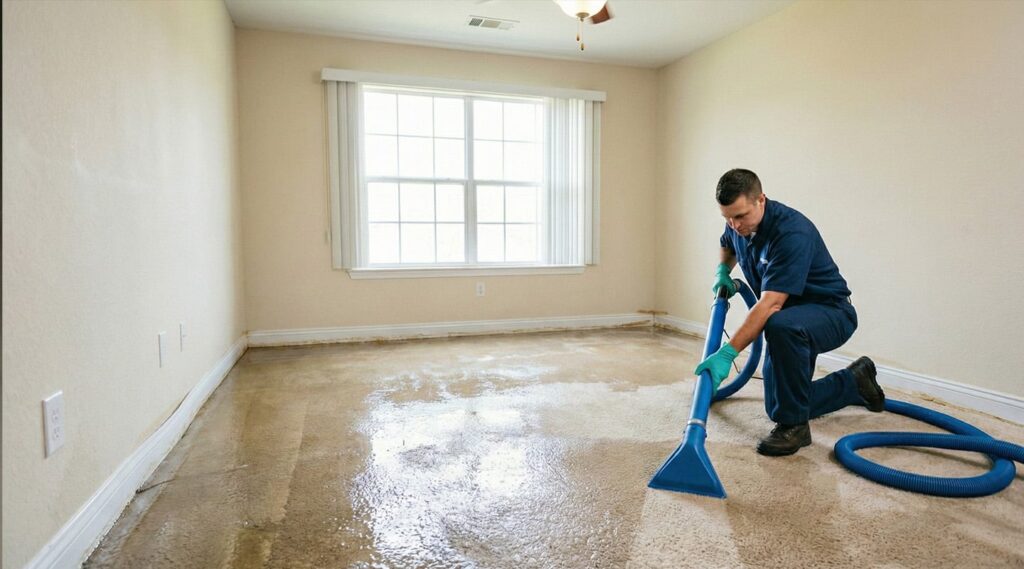
Running equipment removes moisture. It does not remove what the water carried into the carpet system — bacteria, sediment, organic debris, or the contamination that comes with greywater and sewage backup events.
The IICRC S100 standard classifies carpet restoration by water category, and the treatment changes entirely based on source. Clean water from a supply line requires extraction, drying, and antimicrobial treatment. Greywater from appliances or storm overflow almost always requires pad removal and subfloor treatment regardless of how intact the carpet appears. Water damage cleanup Houston TX events involving street flooding regularly involve Category 3 contamination — biologically hazardous water requiring complete material removal under specific disposal protocols, not extraction and drying.
Professional Houston water damage cleanup also accounts for something national guides consistently underestimate: ambient humidity. Houston’s outdoor air runs 80 to 90% relative humidity during summer months. Air movers without sealed containment pull that outdoor air directly into the drying environment, reversing overnight progress by morning. Experienced operators seal and condition the space from outside air. Operators who do not account for it leave equipment running days longer—at the homeowner’s expense.
What ‘Waiting to See’ Costs — and What a Water Remediation Company Prevents:
The homeowners who call three weeks later do so because a corner of the room has gone black, the subfloor has a soft spot near the baseboard, or a pre-sale air quality inspection came back flagged.
Mold does not stay in the room where water entered. It follows humidity through wall cavities, spreads across subfloor surfaces, and moves through HVAC systems into rooms that were never wet. Remediation at that stage costs three to five times what prompt professional treatment would have cost in the first 48 hours. A water remediation company that treats contamination during the restoration window eliminates that escalation entirely. Waiting does not.
Frequently Asked Questions:
Q1: Why does my carpet still smell after it dried out?
Odor that returns after apparent drying almost always means the source was never addressed—the moisture was removed from the surface but contamination remains in the backing, pad, or subfloor. Smell that is worse on humid days confirms this: moisture in the air reactivates volatile organic compounds from bacterial activity that was not fully eliminated.
Surface cleaning or deodorizing does not resolve this. Full extraction, antimicrobial treatment targeting the backing and subfloor, and verified moisture readings are what eliminate the source rather than masking it.
Q2: Should I replace or try to restore my water-damaged carpet?
The decision follows the water category and elapsed time, not appearance. Category 1 (clean water) with fast professional response: restoration is usually viable. Category 2 (greywater) or any event with a delayed response: replacement is often more cost-effective than restoration and sometimes required. Category 3 (sewage or floodwater): full replacement under specific disposal protocols with no exceptions. A contractor quoting restoration on category 3 carpet is cutting corners that will create a mold and health problem six weeks later.
Q3: Can water-damaged carpet always be saved?
Not always—it depends on two factors: water category and response time. Carpet soaked in clean water (Category 1) with professional extraction within 24 to 48 hours can often be fully restored. Carpet exposed to grey water from appliances or storm overflow, or any carpet where professional response was delayed beyond 72 hours, typically requires replacement regardless of how it looks. The pad is almost always replaced regardless of water source—foam padding does not dry reliably and is not worth the contamination risk to attempt saving.
Q4: Does homeowners insurance cover professional carpet cleaning after water damage?
Most standard homeowners policies cover sudden, accidental water damage from internal sources—burst pipes, appliance failures, and storm-related roof damage that allows water in. They do not cover gradual leaks from deferred maintenance or flooding from external rising water, which requires separate flood insurance.
Coverage typically includes extraction, drying, material treatment, and replacement where necessary, minus your deductible. Document the damage with photographs before any work begins and confirm the scope with your adjuster before contractors start—adjuster approval of the scope is what determines what gets covered.
Final Thoughts:
Water damage to carpet is not a surface problem—it is a systems problem that develops below the finish for days after the visible water is gone. Water damage restoration done correctly does not rely on how the surface feels.
It relies on what the meters read two inches below it. Waiting to confirm that is not caution. It is how a recoverable situation becomes a structural one.