
In March 1982, rain and runoff from the spring thaw pushed the Maumee, the St. Joseph and the St. Marys past their banks and into Fort Wayne. Wire reports from that week describe basements filled with water and several inches standing on some first floors. It was the worst flooding here since 1913, and the volunteer sandbagging effort that followed is why Fort Wayne still calls itself the city that saved itself.
Then Fort Wayne fixed it — not overnight, and not before the rivers came up again in 1985 and 1991. Working with the Army Corps of Engineers, the city eventually built roughly ten miles of higher levees along all three rivers, and the plan worked. Most people living here now have never watched a river come over a wall, and spring thaw has quietly stopped registering as a threat.
Which is the problem.
Levees stop water that arrives over the top. They do nothing about water that arrives sideways, through saturated soil, into the lowest opening in the house. That is where crawl space water damage comes from in Allen County — and unlike 1982, nobody photographs it.
The Ground Thaws From the Top Down:
Everyone knows frozen soil behaves like pavement. What gets missed is that it does not thaw all at once, and the sequence is what puts water in your crawl space.
Researchers who have tracked Indiana soil temperatures since 1966 found that deeper soil layers stay frozen for more consecutive days than the layers above them. So during a February thaw there is a stretch of days when the top few inches have softened and will happily take on water, while a frozen layer sits underneath refusing to pass it along.
The surface saturates, and everything after that runs off sideways — toward the one place where the ground was dug up, backfilled and never fully re-compacted. The trench around your foundation.
The corollary is worth holding onto: the harder the winter, the worse this gets. Field studies have found that a thick frost layer hinders meltwater infiltration, while a thin one lets most of it soak straight through. A mild January is not the year to worry. The year to worry is the one after a long deep freeze.
From there it moves down the outside of the wall and looks for an opening. A crawl space vent, a gap at the sill, a hairline crack in a block joint. This is the version of spring thaw flooding that never makes the news — no river, no evacuation, just standing water under a house nobody has looked at since the closing inspection.
The Signs Show Up Upstairs First:
The useful thing about the signs of hidden water damage is that the earliest ones appear upstairs, in rooms you use every day, long before anyone thinks to open the hatch. Those are the ones to know:
- A musty smell with no visible source, strongest near floor vents or on the first warm day of spring
- Hardwood that has begun to cup, edges higher than the center — the underside is wetter than the top
- Floors that stay cold in a way that carpet and slippers do not fix
- Allergy symptoms that track the seasons rather than the pollen count, and ease off when you leave the house
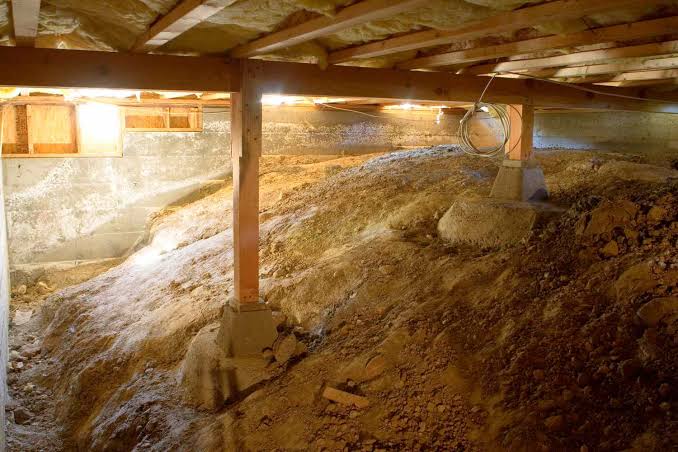
Once any of those send you down the hatch, the crawl space itself tells a blunter story. Look for white, chalky efflorescence on block walls — mineral salt left behind by water that has already passed through the masonry — along with rust on ductwork straps and joist hangers, and insulation sagging away from the subfloor.
That last one deserves a note. Fiberglass does not fall because the staples failed. It falls because it absorbed enough water to get heavy, which means the subfloor above it has been damp for a good while.
If you have a basement rather than a crawl space, the upstairs signs are the same and the downstairs ones shift. Efflorescence still applies. So does rust. What replaces sagging insulation is the cove joint — the seam where the wall meets the slab — which is where lateral water almost always shows up first: a darker band along the base of the wall, or a faint high-water line that reappears every March in the same place.
Your Crawl Space Air Is Your Air:
Warm air rises and leaks out the top of a house, which drops the pressure below and pulls replacement air in through the lowest opening available. That is the stack effect, and in a house with a crawl space, the lowest opening is the crawl space.
One figure gets quoted constantly — that 40 to 50 percent of first-floor air comes from below. Treat it as a rule of thumb, not a measurement; the real number depends on how leaky the house is. The direction is not in dispute, though. Whatever is down there is, to some degree, in your kitchen.
Which matters because the EPA puts the mold threshold at 60 percent relative humidity. A wet crawl space clears that easily, and the musty odor upstairs is not a smell drifting up from somewhere else. It is the air you are breathing.
Why Crawl Spaces Dry So Slowly:
If there is one expectation I would reset before anyone takes a quote, it is the timeline. An open basement is a cooperative drying environment: volume, headroom, power, room for equipment. A crawl space offers none of it — a few feet of clearance, a dirt floor that holds moisture like a sponge, joist bays that trap still air, and often a hatch too small for a large dehumidifier.
The same volume of water takes far longer to remove, and drying has to be verified rather than assumed — meter readings in the framing, not a hand on the joist.
Basements dry faster but hide more. Unfinished, the problem is visible and the drying is straightforward. Finished, the water gets behind drywall, under laminate and inside stud bays, and the cove joint where it entered is sitting behind a baseboard nobody wants to pull. The material comes out either way; finishing just decides how much of it.
What encapsulation does, and does not, do
Encapsulation — a sealed vapor barrier across the ground and up the walls, with a dehumidified interior — works well on the problem it addresses. Advanced Energy’s field research comparing sealed and vented crawl spaces found sealed ones held substantially lower average humidity, and the International Residential Code has permitted the approach for years.
What it does not do is stop bulk water. If meltwater is coming through a foundation wall, a vapor barrier will not turn it away — it holds it against the wall and hides it. Encapsulation manages moisture; it is not waterproof. Installed over an active leak, it buys a tidier crawl space with the same problem underneath. Grading, gutters and drainage come first.
One Season Versus Three:
After one wet spring the damage is mostly biological. Surface mold on joists and the underside of the subfloor, odor reaching the hallway, insulation starting to sag. All reversible, and the cost is remediation plus a dehumidifier.
After three, the arithmetic changes. Wood held above roughly 20 percent moisture content through repeated cycles stops merely hosting mold and starts hosting decay fungi, which eat the wood rather than live on it. Fasteners corrode, subfloor loses stiffness, and the hardwood above cups permanently instead of relaxing back. At that point you are not drying anything. You are replacing framing.
Water Company or Mold Company?
Fair question, and the answer is usually both. This is a water problem that has turned biological, and splitting it between two contractors tends to produce two partial scopes. Most national brands here run as networks of locally owned businesses, so one firm often holds a mold remediation franchise and full water mitigation capability under one roof.
When comparing restoration franchises, ask practical questions. Will they take readings in the framing rather than the air, find the water source before proposing a barrier, and carry the job from extraction through verification? Steamatic of Fort Wayne works across Allen County on that basis.
Frequently Asked Questions:
Q1. How often should I actually look in my crawl space?
Twice a year — late spring once the thaw has run its course, and again in fall. Bring a flashlight and look for standing water, sagging insulation, rust and white staining on block. If there is water down there, do not go in until the power to any circuits or equipment in that space is off, and skip the trip entirely if you see sewage or heavy mold growth.
Q2. Will opening the vents dry it out?
Often the opposite. Warm, humid outdoor air entering a cool crawl space loses its capacity to hold that moisture and drops it on the framing. Ventilation helps in dry conditions and hurts in humid ones.
Q3. Is a little standing water in spring normal here?
Common, yes. Normal, no. Water that shows up every March is pointing at a drainage problem, and it is far cheaper to fix at the gutter and grading stage.
Final Thoughts:
The levees did their job. Fort Wayne solved the flood that made headlines, and the rivers have not taken a neighborhood in decades. But the water that damages houses here now arrives in no crest anyone can watch. It seeps in over a few weeks in March, sits where nobody visits, and announces itself a year later as a smell in the hallway.
So go look, once the thaw has finished. The thing to remember is that this damage is cheap early and expensive late — one season is a dehumidifier, three is a framing bill. If what you find is worse than expected, water damage restoration in Fort Wayne starts with finding the source rather than covering it, and the broader restoration and cleaning services follow from there.