

Most Indianapolis basements are not dry because the ground around them is dry. They are dry because a pump is running.
Marion County sits on glacial till, and its dominant Miami-Crosby soils are close to the worst thing you can build a basement into. Under the topsoil lies a layer of dense till that county soil surveys rate at less than 0.06 inches per hour — functionally a lid. Rain cannot drain down through it, so it backs up and moves sideways instead, toward the nearest vertical surface. Usually a foundation wall.
The USDA’s official series description for Miami soils puts it precisely: a perched water table sits two to three feet below the surface from December through April in a normal year. Not groundwater welling up from below — rainwater stacked on top of a layer it cannot get through, pressing outward against everything in its way.
That is the pressure a basement wall holds back for roughly a third of the year, and across Marion, Hamilton and Boone counties the thing keeping the result off the floor is one appliance that costs a few hundred dollars. Which is why sump pump failure is the most common trigger of basement water damage in central Indiana — not burst pipes, not sewer backups, not storms by themselves.
And here is the part that gets people. A pump that has quit looks exactly like a pump that is working.
The Pump Is Usually Fine:
Walk through the ways these systems fail and a pattern emerges: the motor is rarely the problem.
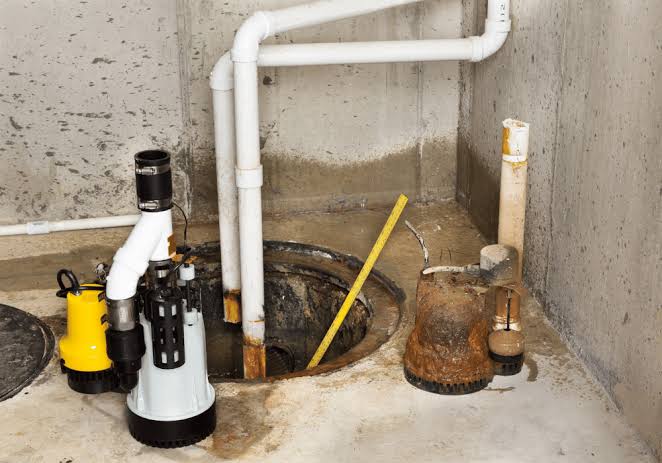
- The float switch sticks. Silt in the pit, or a pump that has vibrated against the basin wall and snagged its own float cord. The motor is fine. It never gets the signal.
- The discharge line freezes or clogs. An Indiana January freezes a shallow, poorly pitched run solid. The pump works against a closed pipe and the water comes right back into the pit.
- The pump is outmatched. A unit that handles an ordinary April meets a two-inch storm, falls behind and never catches up.
- The power is gone. Nothing wrong with the pump at all.
- The pump really is worn out. This is the only one on the list where the answer is a new pump.
Four of those five are a healthy motor sitting in a hole doing nothing. Which is why swapping the pump is so often the wrong first move — people spend three hundred dollars on a new unit and leave the frozen discharge line exactly where it was.
The GFCI Trip Nobody Checks:
If I could get every homeowner in Hamilton County to check one thing, it would be the outlet.
The National Electrical Code requires ground fault protection on sump pump circuits, which is why yours is plugged into a GFCI outlet — the kind with the reset button on it. That is a sound rule; a wet basement with a grounded appliance in it is what GFCIs are for. The complication is that a sump pump draws a heavy load the instant it kicks on, and that surge is enough to trip some outlets with no real fault behind it. When it happens, nothing tells you. No noise, no smell, no blinking light. The pump looks identical to one running fine, and it can sit dead for weeks until the first heavy rain finds it.
There is a trap here too. If you have a water alarm plugged into that same outlet, one trip kills the pump and the alarm together. The alarm belongs on a different circuit, and the pump is better off with one of its own. Push reset, then test the pump. If it trips again, that is not a nuisance — that is a failing seal or motor winding, and an electrician’s problem rather than a plumber’s.
The Pump Quits Exactly When You Need It:
The other failures are bad luck. This one is closer to a design flaw. The conditions that fill a sump pit — slow-moving storms, saturated ground, wind — are the same ones that drop power lines, so the pump goes dark at the exact hour it has the most work to do. Eight flawless years count for nothing if the unit spends one evening not being a pump.
The Five-Minute Test:
FEMA’s homeowner guidance on sump pump maintenance puts it about as plainly as it can be put: pour a bucket of water into the pit and confirm the pump turns on. That is the whole test. FEMA also says to replace the pump if it is more than ten years old, if deep puddles form outside when it rains, if you never hear it run, or if you hear it switching on and off during rain. While you are down there, listen. A healthy cycle is a steady hum that ends cleanly. A grind, a rattle, or a motor humming without moving water means a blocked discharge — confirm it in thirty seconds by stepping outside to see whether water is coming out. Clear the silt around the float before you go up.
Battery vs. Water-Powered Backup:
In central Indiana, a backup is not an upgrade. It is part of the system. When the water table sits above your basement floor for weeks at a stretch, one pump on one circuit is a single point of failure guarding the most expensive square footage in the house.
A battery backup works in any house and moves serious volume, commonly 2,500 to 3,500 gallons per hour. The catch is runtime: a battery is a finite tank of energy and a multi-day outage empties it. Batteries also degrade quietly, so the system depends on you remembering it exists.
A water-powered backup has no battery and no runtime limit, since it runs on municipal pressure. The trade-offs are real: it needs roughly 40 to 60 psi, consumes about a gallon of city water per two gallons removed, and requires a backflow preventer installed by a licensed plumber. Some municipalities restrict them outright. And it is no help on well water, because the well pump dies in the same outage. On city water with good pressure, the water-powered unit handles long outages better. On a well, the battery is your only option.
What the First 24 Hours Look Like:
If the pump loses and you come downstairs to standing water in basement space, what follows is fairly consistent. Extraction first, because nothing dries while water sits on it. Then the sorting, which is less forgiving than most people expect. Groundwater that has passed through soil is not clean water. Carpet pad is a loss, and usually so are cardboard, particleboard and anything upholstered that wicked. Hard non-porous items clean up fine. Drywall gets cut above the waterline, since it draws moisture past the visible mark, and the insulation behind it goes too.
This is where finished basements get expensive. Unfinished space is mostly concrete and open framing and dries quickly. A finished basement hides wet material behind vapor barriers, under laminate and inside stud bays, so flooded basement cleanup takes longer and needs more selective demolition.
Structural drying commonly runs three to five days once removal is done. The EPA advises drying wet materials within 24 to 48 hours to prevent mold — a window that starts when the water arrives, not when you notice it.
Who Actually Shows Up:
Basements rarely flood at a convenient hour, so this is worth knowing in advance. Most national restoration brands are networks of locally owned businesses rather than corporate branches, and when a disaster restoration franchise is staffed by people living in the same county, crew and equipment are already nearby — which matters when the mold clock runs in hours.
Worth asking any restoration company franchise where equipment stages and whether one technician carries the job from extraction through drying. Steamatic of North Indianapolis serves Marion, Hamilton and Boone counties on that model.
Frequently Asked Questions:
Q1. How often should I test my sump pump?
FEMA suggests once a year. In central Indiana, twice is better — early spring and late fall — plus a quick check when heavy rain is forecast and you have not run it recently.
Q2. Does homeowners’ insurance cover a failed sump pump?
Usually not under a standard policy. Coverage for sump pump failure and water backup is typically sold as a separate endorsement with its own limit. Check your declarations page before you need it.
Q3. Can I clean up a few inches of water myself?
Before anything else: do not step into a flooded basement until the power to it is off at the panel. Water and live circuits share that floor. Once it is safe, removing surface water with a wet vacuum early does help — but household equipment cannot dry what is underneath. Subfloor, wall cavities and framing hold moisture that surface drying never reaches.
Final Thoughts:
A sump pump is the least glamorous piece of equipment in a central Indiana house and one of the most consequential. It sits unattended in a hole in the floor for a decade and gives almost no warning when it stops. So if you remember one thing, make it this: before you buy a new pump, check the outlet, the float and the discharge line. The motor is usually innocent. Five minutes with a bucket twice a year catches most of the rest.
If that ship has sailed, the priority is getting water out and drying started fast: water damage restoration in Indianapolis is a race against the 48-hour window more than anything else. You can also review the full range of restoration and cleaning services that follow a basement flood.